


Section 10 of Income Tax Act - Exemptions and Allowances
Section 10 of the Income-tax Act, 1961, provides exemptions to ease the income tax burden for salaried professionals. It outlines criteria for tax exemptions and focuses on income sources excluded from total income calculations.
What is Section 10 of the Income Tax Act?
Section 10 of the Income Tax Act specifies various categories of income that are exempt from taxation in India. It outlines incomes that are not included in the taxable income of individuals or entities.
It helps to reduce overall tax liability, especially for salaried taxpayers. Common exemptions available under this section include Leave Travel Allowance (LTA), House Rent Allowance (HRA), and children’s education allowance.
Features of Section 10 of Income Tax Act
The following are the significant features of section 10 of Income Tax Act 1961:
- Computation of Total Income: Calculating total income for salaried individuals requires a detailed evaluation of all earnings, exemptions, and applicable tax liabilities.
- Tax Benefits for Salaried Individuals: Salaried taxpayers can avail exemptions on certain incomes, such as proceeds from life insurance policies under Section 10(10D), subject to conditions.
- Availability of Tax Exemptions: Section 10 offers multiple exemptions that help lower taxable income.
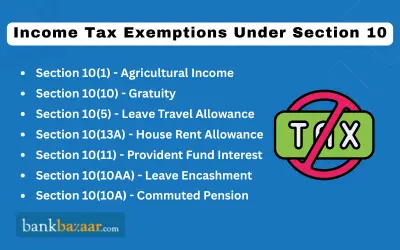
Common exemptions include:
- House Rent Allowance (HRA)
- Leave Travel Allowance (LTA)
- Children’s education allowance
- Gratuity and other retirement benefits
Who can Claim Tax Exemptions under Section 10?
The criteria that must be met to claim tax exemptions under Section 10 are mentioned in the table below:
Age | Tax Exemption (Maximum) |
Under 60 years | Rs.2.5 lakh in a financial year |
Between 60 years and 80 years | Rs.3 lakh in a financial year |
More than 80 years | Rs.5 lakh in a financial year |
Overview Table of Major Exemptions Under Section 10
The summary of major exemptions under Section 10 of Income Tax Act are listed in the table below:
Section | Nature of Exemption | Key Details |
10(1) | Agricultural Income | Income from agricultural land in India is fully exempt |
10(2) | HUF Income | Amount received by a member from HUF is tax-free |
10(2A) | Partner’s Profit Share | Share of profit from firm/LLP is exempt |
10(5) | Leave Travel Allowance (LTA) | Exemption on domestic travel expenses |
10(6) | Foreign Income Exemptions | Various exemptions for foreign nationals |
10(10) | Gratuity | Exemption based on employment type |
10(10A) | Pension | Commuted pension exemption |
10(10AA) | Leave Encashment | Exempt at retirement (subject to limits) |
10(10D) | Life Insurance | Maturity proceeds exempt (conditions apply) |
10(11)/(12) | Provident Fund | PF withdrawals and interest exempt (limits apply) |
10(13A) | HRA | House Rent Allowance exemption |
10(14) | Allowances | Various employee allowances exempt |
10(15) | Interest Income | Certain interest incomes exempt |
10(23C) | Institutions | Exemption for educational/medical institutions |
10(26) | Scheduled Tribes | Income exempt in specified areas |
10(34A) | Buyback of Shares | Exempt (subject to conditions) |
10(35) | Mutual Funds | Income from specified mutual funds exempt |
Detail List of Exemptions Under Section 10 of Income Tax Act
The list of exemptions under section 10 of Income Tax Act are mentioned below:
Section 10(1) – Agricultural Income Exemption
- Eligible Persons: Individuals and Hindu Undivided Families (HUF)
- Nature of Exemption: Agricultural income is fully exempt from income tax
Important Limitation: Applies only to agricultural income and is not applicable to the following:
- Dairy farming
- Poultry farming
- Animal husbandry
Includes the Following:
- Agricultural Activities: Cultivation processes like tilling, sowing, planting, harvesting
- Rent/Revenue from Land: Income from land used for agricultural purposes
- Agricultural Operations: Income from processing produce and maintaining or raising agricultural produce.
Section 10(2) – HUF Income
- Eligible Persons: Members of a Hindu Undivided Family (HUF)
- Nature of Exemption: Amount received from HUF income or estate is fully exempt
- Key Point: Applies only to income distributed from family income or estate.
Section 10(2A) – Partner’s Share of Profit
- Eligible Persons: Partners in a firm or LLP
- Nature of Exemption: Share of profit received is fully exempt
Not applicable to:
- Interest on capital
- Salary or remuneration from firm
Section 10(5) – Leave Travel Concession (LTC)
- Eligible Persons: Salaried employees receiving LTC from employer
- Coverage: Domestic travel only and includes travel by air, rail, and road.
- Family Definition: Spouse, children, parents, dependent siblings
- Extent of Exemption: Limited to actual travel expenses incurred
- Conditions
- Employees must travel to avail themselves of the exemption.
- Allowed for two journeys in a block of four years.
Section 10(6)(ii) – Foreign Diplomatic Staff in India
- Eligible Persons: Non-Indian citizens working in a foreign embassy, legation, consulate, high commission, or trade representative office in India.
- Exemption: Remuneration received is fully exempt from Indian income tax.
- Condition: Exemption applicable if only if the corresponding Indian official receives a similar exemption in that foreign country.
Section 10(6)(vi) and 10(6)(viii) – Foreign Employees and Non-Residents
- 10(6)(vi): If conditions met, salary of foreign employees of a foreign enterprise for services in India is exempt.
- 10(6)(viii): Salaries for non-resident foreign nationals working on foreign ships in India for less than 90 days per year are exempt.
Section 10(6)(xi) – Foreign Trainees
- Eligible Persons: Foreign trainees undergoing training in India.
- Exemption: Payments or remuneration received during training in government-financed, government-owned, or legally established institutions are exempt.
Sections 10(6)(A) – 10(6)(D) – Foreign Company Income
- 10(6)(A): Tax paid by Indian government on behalf of foreign company earning royalty for technical services are exempt for the foreign company.
- 10(6)(B): Tax paid by central government on behalf of a foreign company or non-resident are exempt.
- 10(6)(BB): Tax paid by Indian aircraft company on behalf of foreign entity leasing aircraft are exempt.
- 10(6)(C): Notified foreign companies earning royalty or technical fees are exempt.
- 10(6)(D): Fees or royalty for services rendered to NTRO by a non-resident are exempt.
Section 10(7) – Government Employees Abroad
- Exemption: Exemption applies to allowances or perquisites paid by Government of India to employees serving abroad.
Section 10(8) – Cooperative Technical Assistance Program
- Exemption: Direct or indirect remuneration is exempted, which is received from a foreign government for participation in technical assistance programs.
Section 10(8A) and 10(8B) – Consultants and Employees
- 10(8A): Income earned by a consultant under a technical assistance agreement (including income accruing outside India) are exempt.
- 10(8B): If not resident or ordinarily resident in India, employee of the consultant also eligible for exemption.
Section 10(9) – Family Members under Technical Assistance Program
Income of family members of an employee serving aboard under Sections 10(8A) and 10(8B) is exempt from tax.
Section 10(10) – Gratuity and Pensions
10(10)(i):
Gratuity received by government employees is fully exempt.
10(10)(ii):
Exemption applicable on gratuity under Payment of Gratuity Act, 1972, which should be least of either 15 days salary × years of service, Rs.20 lakh, or actual gratuity received
10(10)(iii):
Exemptions applicable to gratuity for employees not under Payment of Gratuity Act, which should be least of either half-month salary × years of service, Rs.10 lakh, or actual gratuity received.
10(10A):
Commuted pensions received by government employees are exempt.
10(10)(AA) – Leave Encashment:
- Government employees are fully exempt
- Non-government employees can also avail themselves of exemptions, whichever is minimum of either earned leave × average monthly salary, 10 months’ salary, Rs.3 lakh, or actual amount received.
10(10B) – Retrenchment Compensation: Exemption is applicable considering the minimum of the following:
- Amount under section 25F(b)
- Rs.5 lakh
- Actual amount received
10(10BC) – Disaster Compensation: Exemption is applied to the compensation received by disaster victims or heirs from central or state government.
10(10C) – Voluntary Retirement or Termination: Exemption for government employees on retirement or termination on maximum of Rs.5 lakh.
10(10CC) – Employer-paid Tax on Perquisites:
Perquisites are taxable, but tax paid by employer on non-monetary perquisites is exempt.
10(10D) – Life Insurance Proceeds: Proceeds from life insurance policy are exempted subject to conditions.
Section 10(11) – Statutory Provident Fund (SPF)
- Employer contributions are not treated as income, and hence interest credited is exempted.
- Lump sum received at termination is also exempted.
Section 10(12) – Recognised Provident Fund (RPF)
- Employer contribution up to 12% of salary is not treated as income.
- Interest credited up to 9.5% p.a. is exempted, while excess interest is taxable.
- Lump sum at termination is exempted if conditions are satisfied.
Section 10(11A) – Sukanya Samriddhi Account
Any payments or interest from the Sukanya Samriddhi Account are also exempted.
Section 10(12A) – National Pension Scheme (NPS)
- Before April 2020: Exemption applied to 40% of total amount payable on account of closure or opting out.
- After 1 April 2020: Exemption applied to 60% of total amount payable.
Section 10(12B) – NPS Partial Withdrawal
Exemption is applied to partial withdrawal up to 25% of total contribution.
Section 10(13) – Superannuation Fund
Employer contribution up to Rs.1.50 lakh is exempted. Payments from fund exempt in cases of:
- Death of employee
- Commutation of annuity on retirement
- Transfer to account under section 80CCD
Section 10(13A) – House Rent Allowance (HRA)
- Exemption for salaried employees paying rent for residential accommodation.
- Exemption limited to minimum of either actual HRA received; rent paid minus 10% of salary or 50% of salary for metro city and 40% for non-metro city.
- Not applicable to the self-employed or employee who owns residential property in the same city.
Section 10(14) – Employee Allowances
Exemption for certain employee allowances, such as:
- Helper allowance
- Uniform allowance
- Travel allowance
- Daily allowance
- Children’s education allowance
- Food allowance for daily expenses during working hours
Note: Exemption subject to conditions and limits may change with updates in law
Section 10(15) – Interest Income
Under this section, various interest incomes that are exempt are listed under different subsections.
Section 10(15A) – Aircraft Lease
If conditions are satisfied, then lease rent of aircraft or aircraft engine paid to a foreign government or foreign enterprise by an Indian company is exempted.
Section 10(16) – Educational Scholarship
Any educational scholarship received is exempted in recipient’s hands.
Section 10(17) – Allowances to MPs/MLAs
Daily allowance or constituency expenditure received by MPs (Member of Parliament) or State Legislators is exempted.
Section 10(17A) – Public Awards
Exemption is applicable to any award or reward received in public interest from the Central or State Government.
Section 10(18) – Gallantry Award Pension
Pension received by gallantry award recipients is exempted.
Section 10(19) – Family Pension (Armed Forces)
Family pension received by armed forces members or their families is exempted.
Section 10(19A) – Former Ruler’s Palace
The annual value of one palace owned by a former ruler is exempted.
Section 10(20) – Income of Local Authorities
Exemption is fully applicable to income from:
- House property, capital gains, and other sources
- Supply of commodity or service
- Business of electricity or water supply
Section 10(21) – Research Associations
Income of research association approved under section 35(1) is exempted, if:
- Income is used for core objectives
- Funds not deposited or invested in ways other than forms or modes specified in section 11(5).
Section 10(22B) – News Agencies
The income of a news agency for distribution and collection of news is exempted.
Note: Exemption not available from Assessment Year 2024-25.
Section 10(23A) – Professional Associations
Income of associations or professional institutions in India supervising Law, Engineering, Accountancy, Medicine, Architecture, are exempted.
Note:
- Income used for primary objectives
- Approved by Central Government
Section 10(23AA) – Armed Forces Funds
Income received on behalf of a public fund or non-regimental fund by armed forces.
Section 10(23AAA) – Employee Welfare Funds
- Income from approved funds for employee welfare is exempted from tax.
- Must be notified by the Board in Official Gazette.
Section 10(23AAB) – LIC or Insurer Pension Funds
Income of LIC or other insurer funds for pensions, approved by Controller of Insurance or IRDAI, is tax exempted.
Section 10(23B) – Village and Khadi Industries
Income of charitable organizations promoting village and khadi industries is tax exempt.
Section 10(23BB) – Khadi and Village Industries Board
Tax exemption is applicable on income received by the Khadi and Village Industries Board.
Section 10(23BBB) – European Economic Community
Tax exemption is applicable on interest, dividend, or capital gains from investments made in India from EEC funds under notified scheme.
Section 10(23BBC) – SAARC Fund
Income from the SAARC fund for regional projects is tax exempt.
Section 10(23BBD) – Asian Organization of Supreme Audit Institutions
Earnings of the Secretariat are exempt from Assessment Year 2001- 2002 to 2010- 2011.
Section 10(23BBE) – IRDAI
Income of IRDAI established under section 3(1) is exempted from tax.
Section 10(23BBG) – Central Electricity Regulatory Commission (CERC)
Income of CERC after A.Y. 2008-2009 is exempted from tax.
Section 10(23BBH) – Prasar Bharati
Tax exemption is applicable on earnings of Prasar Bharati (established under the Prasar Bharati Act, 1990).
Section 10(23C) – Educational and Medical Institutions
Tax exemption applies to the income of certain educational and medical institutions provided institutions are charitable and are government approved.
Section 10(23D) – Mutual Funds
Income from mutual funds registered under SEBI or set up by a public sector bank is exempted from tax.
Section 10(23DA) – Securitization Trust
Income earned by a securitization trust via securitization is not taxable.
Section 10(23EA) – Investor Protection Fund Contributions
- Tax exemption is applicable on contributions received from recognized stock exchanges and members of investor protection funds.
- Taxable if any amount is shared with a recognized stock exchange.
Section 10(23EB) – Credit Guarantee Fund
- Tax exempted on income of credit guarantee fund trust (set up by SIDBI and Government of India).
- Exemption period is five years from 2002-2003 to 2006-2007.
Section 10(23EC) – Commodity Exchange Investor Protection Fund
- Tax exempted on income of notified investor protection fund set up by a commodity exchange.
- Contributions received from commodity exchanges are free from tax.
- The amount shared with the recognized commodity exchange is taxable.
Section 10(23ED) – Depository Investor Protection Fund
- Tax is exempted on income of Investor Protection Fund set up by a depository.
- The amount transferred to a depository is taxable.
Section 10(23EE) – Core Settlement Guarantee Fund
- Specified income of a core settlement guarantee fund set up by a clearing corporation is exempted from tax.
- Amount standing to the credit of the fund and shared with a specified person is taxable.
Section 10(23FB) – Venture Capital Fund
- Earnings of a venture capital fund from investments in venture capital undertaking is exempted from tax.
- Exemption applicable from A.Y. 2001-2002 subject to conditions in Section 10(23FB).
Section 10(23FBA) – Investment Fund Income
Any income received by an investment fund is exempted from tax except for income under “business or profession”.
Section 10(23FBC) – Unit Holder Income
Income received by a unit holder from a specified fund or on transfer of units is eligible for tax exemption.
Section 10(23FC) – Business Trust Income
Tax exemption is applicable on income of a business trust via interest or dividend from a special purpose vehicle (SPV).
Section 10(23FCA) – Real Estate Investment Trust (REIT)
Tax is exempted on income from renting, leasing of real estate assets by a REIT.
Section 10(23FE) – Specified Person Income
- Income received by a specified person in the form of interest, dividend, or capital gains from investments in India is applicable for tax exemption.
- Conditions as per Section 10(23FE) must be satisfied.
Section 10(23FF) – Capital Gains by Non-Residents or Specified Funds
- Capital gains from transfer of shares of an Indian company by a non-resident or specified fund is eligible for tax exemption.
- Exemption applies only to the extent attributable to units held by non-residents.
Section 10(23FD) – Distributed Income from Business Trust
- Distributed income received by a unit holder from a business trust is exempted from tax.
- Tax exemption is not applicable on income already covered under Section 10(23FC) or 10(23FCA).
Section 10(24) – Employer-Employee Welfare Associations
Income under ‘Income from house property’ or ‘income from other sources’ by associations regulating relations between employer and workmen or among workmen is eligible for tax exempt.
Section 10(25) – Provident and Insurance Funds
Tax exemption applies to:
- Interest and capital gains on securities held by a statutory provident fund.
- Income received by the trustee on behalf of a recognized provident fund.
- Income of the board of trustees of a deposit-linked insurance fund.
Section 10(25A) – Employees' State Insurance Fund
Tax exemption applies to any income earned by the Employees’ State Insurance Fund.
Section 10(26) – Scheduled Tribes in Specified Areas
- Members of Scheduled Tribes (ST) living in certain areas (Arunachal Pradesh, Manipur, Meghalaya, Mizoram, Nagaland, Tripura, and Ladakh in J&K) is eligible for exemption.
- Applies to income earned or received from any source in such areas, including dividends or interest on securities.
Section 10(26AAA) – Sikkimese Individuals
- Tax is exempted on income earned by Sikkimese individuals in Sikkim.
- Dividends or interest in securities earned from any area are also exempted.
Section 10(26AAB) – Agricultural Produce Marketing Committee
Income earned by agricultural produce marketing committees regulating marketing of agricultural produce is exempted from tax
Section 10(26B) – Corporations Promoting SC, ST, or Backward Classes
Income of a corporation established by Central/State/Provincial Act or fully government-financed institution promoting interests of Scheduled Castes, Scheduled Tribes, or backward classes is exempted from tax.
Section 10(26BB) – Minority Community Corporations
Income of a corporation established for the welfare of a minority community is exempted from tax.
Section 10(26BBB) – Ex-Servicemen Statutory Corporations
- Tax exemption applies to income of a statutory corporation established for ex-servicemen welfare.
- Applicable from Assessment Year 2004-2005.
Section 10(27) – Cooperative Societies for SC/ST
- Income earned by a government-funded cooperative society benefiting SCs and STs is exempted from tax.
- Tax exemption is applicable if membership consists only of other cooperative societies.
Section 10(29A) – Commodity and Export Boards
Income earned by the following boards and authorities is exempted:
- Tea Board
- Coffee Board
- Agricultural and Processed Food Products Export Development Authority
- Coir Board
- Rubber Board
- Tobacco Board
- Spices Board
- Marine Products Export Development Authority
Section 10(30) – Tea Board Subsidy
Any subsidy received by a person engaged in growing or manufacturing tea in India from the Tea Board is exempted from tax.
Section 10(32) – Income of Minor Child
Tax exemption can be claimed if the income of an assessee includes income of minor child and exemption is applicable. Amount exempt should be (whichever is minimum):
- Rs.1,500 per minor child
- Income of each minor child that has been clubbed with the parent’s income
Section 10(33) – Capital Gains on Unit Scheme, 1964
Capital gains arising from transfer of units of the Unit Scheme, 1964 after 1 April 2002 are exempt from tax.
Section 10(34A) – Income from Buyback of Shares
Income arising to shareholders from buyback of shares is tax exempt, which is applicable if the company pays additional income tax under Section 115QA for such buyback.
Section 10(34B) – Dividend Income from IFSC Aircraft Leasing Units
- Introduced by Finance Act 2023, effective Assessment Year 2024-25
- Dividend income earned by an IFSC unit primarily engaged in aircraft leasing is exempted from tax.
- Tax exemption is applicable if dividend-paying company must also be an IFSC unit engaged in aircraft leasing.
Section 10(35) – Income from Specified Mutual Funds
Tax exemption is applicable on any income gained from the sale of specified mutual fund units.
Section 10(37) – Compulsory Acquisition of Agricultural Land
Capital gain arising from transfer of agricultural land in an urban area by compulsory acquisition is exempt which is applicable if:
- Compensation received on or after 1 April 2004.
- Land used for agricultural purposes by taxpayer or parents for more than two years immediately before transfer.
Section 10(37A) – Andhra Pradesh Land Pooling Scheme
Tax is exempted on capital gain arising from transfer of specified capital assets under AP land pooling scheme by Individual or HUF.
Section 10(38) – LTCG on Equity Shares / Mutual Funds
- Exemption from tax on long-term capital gains (LTCG) from sale of equity shares or units of equity-oriented mutual funds.
- Tax exemption is applicable on Securities Transaction Tax (STT) must be paid at transfer.
Note:
- No exemption from Assessment Year 2019-2020 onwards.
- LTCG above Rs.1 lakh is taxable at 10% under Section 112A.
Section 10(39) – Income from International Sporting Events
Any income of a notified person earned from international sporting events in India is exempted from tax. Exemption applicable if:
- Event approved by international sporting body
- Event notified by Central Government
- Participation by more than two countries
Note: This tax exemption is applicable from Assessment Year 2006-2007.
Section 10(40) – Grant to Subsidiary Power Companies
Grant received by a subsidiary from its Indian holding company engaged in generation, transmission, or distribution of power is exempted from tax.
Section 10(42) – Non-Profit Bodies under Multilateral Treaty
- Specified income of a non-profit body or authority notified by the Central Government is tax exempted.
- Condition: Body formed under a multilateral treaty agreement to which the Central Government is a signatory
Section 10(43) – Reverse Mortgage Loans
Tax is exempted on any amount received as a loan in a reverse mortgage transaction.
Section 10(44) – New Pension System Trust
Income received by the New Pension System (NPS) Trust established on 27 February 2008 is exempt from income tax.
Section 10(46) – Government Trust for Public Welfare
- The income of a trust established by the government is exempted from income tax.
- Restriction: Must not perform commercial activities
- Notification: Must be notified by the Central Government in Official Gazette
Section 10(47) – Infrastructure Debt Fund
Tax exemption applicable on earnings of a notified infrastructure debt fund set up under rule 2F.
Section 10(48) – Sale of Crude Oil by Foreign Company
Tax exempted on income received in Indian currency by a foreign company from sale of crude oil in India. Exemption from tax is applicable if:
- Central Government approval
- Income is of national interest
- Foreign company performs no other activity in India except receiving income
Section 10(48A) – Storage of Crude Oil by Foreign Company
Income from storage of crude oil in India, sold to Indian residents is exempted.
Note: Exemption is applicable if the activity is in national interest and is as per the agreement with the Central Government.
Section 10(48B) – Sale of Leftover Crude Inventory
Tax is exempted on the income of a foreign company from sale of leftover inventory of crude oil from an Indian facility.
Section 10(48D) – Finance for Infrastructure Development
- Earnings of institutions providing finance for infrastructure development.
- Exemption is applicable for 10 consecutive years from the assessment year of establishment.
Section 10(48E) – Development Finance Institution (DFI)
Income of a DFI licensed by RBI is exempt for five consecutive years from the year of establishment.
Section 10(49) – National Financial Holdings Company
- Tax is exempted on earnings of National Financial Holdings Company Limited, set up by Central Government.
- Applies for assessment years starting before 1 April 2014.
Section 10(50) – Equalization Levy on E-Commerce
Detail List of Exemptions Under Section 10 of Income Tax Act
Special Individuals Receiving Allowances Exempt
There are certain individuals who also receive allowances exempt under Section 10(11):
- Allowances granted to High Court Judges.
- Allowance given to a UNO employee.
- Sumptuary allowance received by Supreme Court and High Court Judge.
- Allowances granted to government employees who are Indian citizens, working abroad.
According to Section 10(11A) of the Income Tax Act, this is an income tax exemption for anyone working outside India and representing India in that country:
- Trade commissioners, High ranking Embassy officials, and other officers, are eligible for the benefits of this provision.
- For employees working in foreign enterprises provided their living tenure in India should not exceed 90 days, and the company does not have trade or business in India.
How to Claim Exemption under Section 10?
To claim an exemption under Section 10 on your taxes, you will need to follow the standard procedure for filing your income tax return.
- Collect all the necessary information related to your income and the specific exemptions you are eligible for under Section 10 of the Income Tax Act.
- Use either the physical forms provided by the Income Tax Department or opt for e-filing through the official website or authorized platforms.
- In your tax return, accurately disclose all sources of income, including those eligible for exemptions under Section 10. This may include income from dividends, capital gains, agricultural activities, etc.
- Clearly indicate the exemptions you are claiming under Section 10. Provide details of the specific subsections or clauses applicable to your situation.
- Depending on the exemption, you may need to provide supporting documents such as investment proof, certificates, or other relevant paperwork.
- Double-check all the information provided in your tax return to ensure accuracy and completeness. Once verified, submit your return either electronically or by post as per the prescribed procedure.
- Retain copies of your filed tax return and any supporting documents for future reference or in case of any queries or audits by the tax authorities.
FAQs on Special Allowances under Section 10 for Salaried Employees
1.Is Section 10 exemption available under the new tax regime?
Yes, income tax is exempted up to Rs.1.5 lakh of maturity benefits of insurance policy and if total premium paid is less than or up to Rs.5 lakh other than ULIPs, under section 10.
2.What are the eligibility criteria for Section 10(10D)?
You need to be an EPF member with the age of 58 years or 50 years for reduced pension to be eligible for the exemptions under section 10(10D).
3.What does Section 10 (9) exempt?
under the Cooperative Technical Assistance Program, the income of the family members of the foreign employees is exempted under section 10(9).
4.What is the tax benefit of Section 10 (10D)?
Under Section 10 (10D) an individual can avail themself of tax benefits on maturity of a Life Insurance policy.
5.Is special allowance taxable for salaried employees?
Yes, special allowances are taxable for salaried employees and are paid on monthly basis, which are categorised into various forms, such as official allowance and personal allowance.
6.What is the special allowance for salaried employees?
Special allowance is a certain sum of money paid to the salaried employees by their employers to meet certain needs. The amount is pre-determined, and the amount is a fixed sum of extra amount set for all business entities from sole proprietorships to corporates.
7.Is special allowance considered for gratuity?
No, special allowance is not considered for gratuity, as the calculation of gratuity constitutes of only Basic salary and Dearness Allowance (DA) and no other components.
8.What is the Income Tax Act's Section 10?
Section 10 of the Income Tax refers to income not used to calculate a person's total tax liability. This exempted income is not a part of the total income while calculating the tax liability of the individual.
9.What are the exemptions that fall under Section 10?
Section 10 exempts Pension, LTA, gratuity, encashment of leave, voluntary retirement scheme, and HRA.
10.How to compute taxable income after Section 10?
After deducting the allowances exempt under Section 10, the total taxable salary would be computed.
11.What is the maximum amount you can claim under Section 10?
If you are under the age of 60 you can be exempted for Rs.2.50 lakh and if you are a senior citizen then your basic tax exemption limit is Rs.3 lakhs.
12.Is Dearness allowance (DA) and special allowance the same?
No, DA is paid only to central government employees while special allowance is applicable for employees belonging to both private and public sector.
13.Can my special allowance be higher than my basic pay?
Yes, only in rare cases. The general norm is that the basic pay is higher than the special allowance.
14.Who is eligible for Special Allowance and why is it given?
According to section 17, clause (2), Employees are provided with any exceptional allowance benefit that is not a requirement to fully pay for certain expenses incurred while carrying out the responsibilities of a profitable office or job.
15.What is the difference between Allowance and Perquisites?
While an allowance is money given to an employee for any reason, perquisites are a variety of services provided by their employers.

Disclaimer
Credit Card:
Credit Score:
Personal Loan:
Home Loan:
Fixed Deposit:


Copyright © 2026 BankBazaar.com.